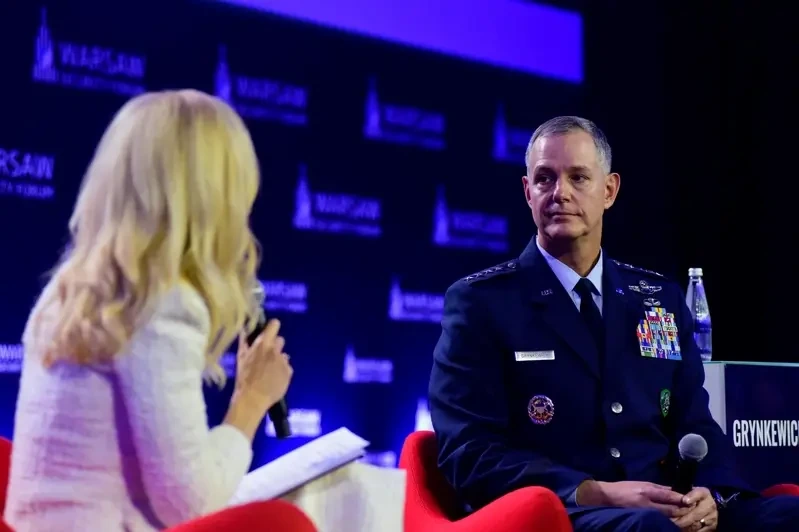
As Russia continues to pressure European nations through sabotage, arson, cyberattacks, and disinformation, NATO’s top military commander, U.S. Air Force General Alexus Grynkewich, took the rare step on the 12th of publicly revealing the core of NATO’s classified war plans. He disclosed that should Russian forces attack a NATO member state, the alliance would employ a three-stage strategy: “block, blunt, and break.”
Speaking at the Warsaw Security Forum, Grynkewich stated that while NATO does not view a military conflict with Russia as “imminent or inevitable,” Russia has recently been using sabotage, arson, cyberattacks, and disinformation to undermine Europe’s resolve to support Ukraine and to attempt to sever supply lines for military aid. Given this context, he decided to make public this operational concept—dubbed NATO’s “theory of victory”—to reassure the roughly one billion citizens across the alliance’s 32 member states that NATO is prepared.
Under this strategy, NATO would first immediately “block” an invasion at the border, preventing enemy forces from seizing territory—a departure from some defensive mindsets that existed prior to Russia’s full-scale invasion of Ukraine. Next, the alliance would strike advancing forces from land, sea, and air to “blunt” their offensive and momentum. If the attack persisted, NATO would then strike supply, communication, and command networks to “break” the enemy’s ability to conduct frontline operations.
Grynkewich noted that the new strategy draws directly from combat experiences in Ukraine and the Middle East. Beyond precision weaponry, it will make extensive use of lower-cost autonomous systems, drones, and electronic warfare equipment to sustain what could become a prolonged war of attrition. NATO emphasized that the objective is not to seize enemy territory but to strip invading forces of their combat capabilities, thereby avoiding giving the adversary a pretext to escalate the conflict.
Concerns in Europe regarding the Russian threat continue to mount. On the 12th, the head of Czech intelligence warned that Russia could escalate its actions within “months rather than years,” and did not rule out the possibility of limited military action against NATO countries in the future. Polish Prime Minister Tusk has also stated that Ukraine’s defense is inseparable from NATO’s security, and that any action undermining Ukraine’s resistance to Russian aggression would compromise his own country’s security.
However, even as NATO unveils its blueprint for potential conflict with Russia, significant political divisions have emerged within the alliance. U.S. President Trump has recently eased sanctions on Russia in an effort to lower diesel prices and has publicly pressured Ukraine; meanwhile, Europe maintains that only by sustaining military and economic pressure on Moscow can Russian President Putin be compelled to halt the war.